SaaS Billing Models: Subscriptions, Seats, Credits, and Add-ons
How to choose and implement SaaS billing models with Stripe, LemonSqueezy, seats, credits, trials, webhooks, and customer portals.
Billing is product strategy expressed in code. If your starter only handles a single checkout link, you will rebuild it as soon as pricing changes.
This article breaks down the billing models a SaaS foundation should support.
Flat Subscription
The simplest model is one plan, one recurring price.
Use it when:
- The product has a clear single package.
- Usage does not vary much across customers.
- Support and infrastructure costs are predictable.
Implementation needs:
- Checkout session.
- Subscription created webhook.
- Subscription updated webhook.
- Subscription canceled webhook.
- Customer portal.
- Plan state in the database.
Tiered Plans
Most SaaS products need at least two paid tiers.
Typical differences:
- Feature access.
- Usage limits.
- Support level.
- Number of seats.
- Data retention.
- Integrations.
Store planId in your subscription table and map it to a local plan catalog. Do not rely on provider price IDs as your product logic.
Seat-Based Billing
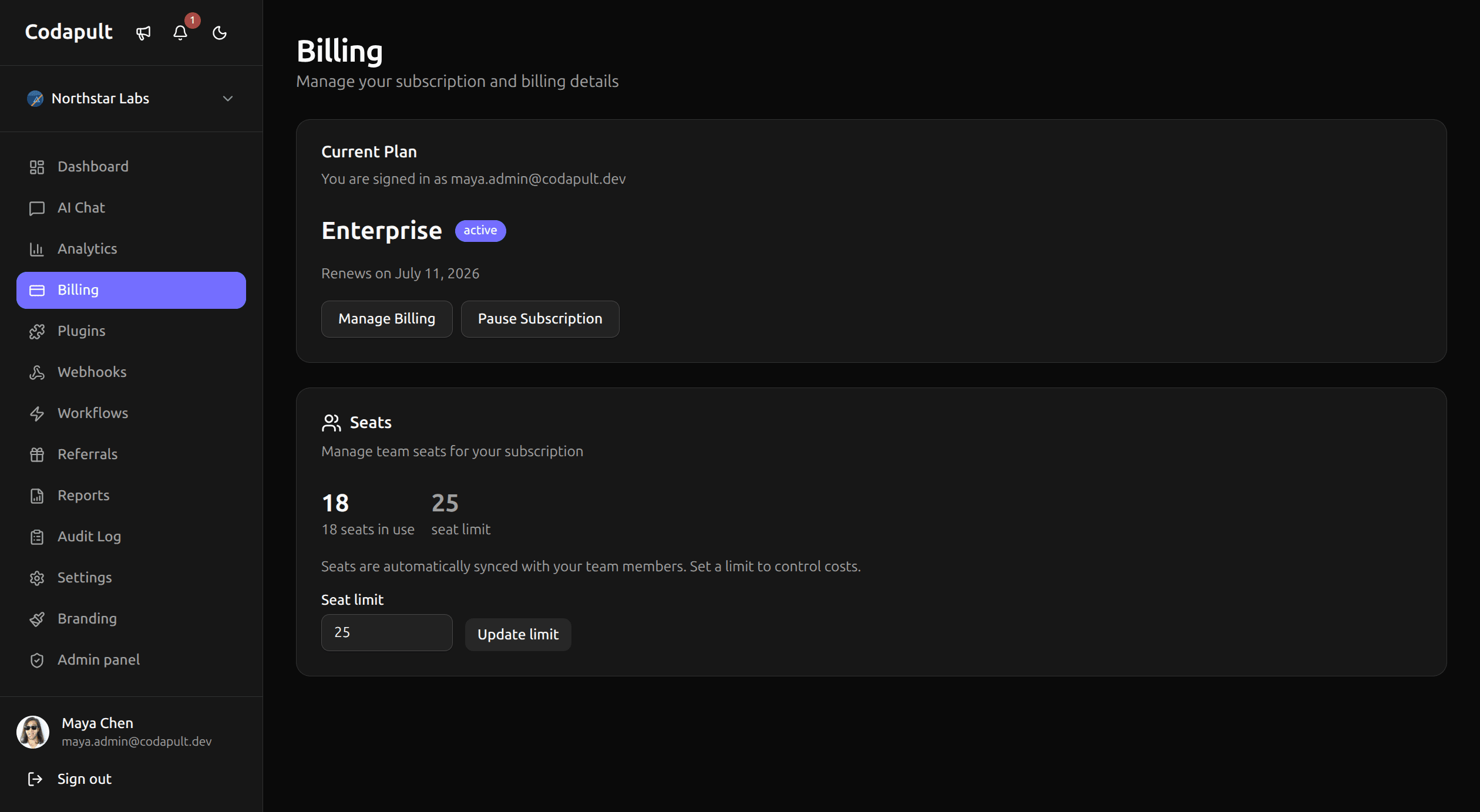
Seat billing is common for B2B SaaS. It aligns price with customer team size.
You need:
- Current seat count.
- Optional max seat cap.
- Member invite logic.
- Checkout or subscription update flow.
- Billing UI that explains renewal impact.
Usage Credits
Usage credits work well for AI, API calls, file processing, or metered workflows.
Track:
- Total credits.
- Used credits.
- Reset date.
- Usage events.
- Budget alerts.
- Overage policy.
Credits should be visible to the customer before they become a billing surprise.
Add-ons
Add-ons let you expand revenue without forcing every customer into a higher tier.
Examples:
- Extra storage.
- White-labeling.
- Priority support.
- Advanced analytics.
- Additional AI credits.
- Premium integrations.
Your checkout and subscription state need to support multiple line items, not just one plan.
Trials
Trials are useful when activation requires product usage. They are less useful when setup is complex and a sales conversation is needed.
If you support trials, store:
- Trial end date.
- Trial status.
- Conversion events.
- Reminder schedule.
- Cancellation behavior.
One-Time Purchases
Some developer products sell lifetime access or source code licenses. That model needs different state than recurring SaaS:
- License tier.
- Project count.
- Update period.
- Support period.
- Delivery workflow.
- Receipt and access email.
Do not mix one-time license logic into recurring subscription code without clear types.
Webhooks Are the Source of Truth
Checkout success pages are not enough. Provider webhooks should update your database.
At minimum, handle:
- Checkout completed.
- Subscription created.
- Subscription updated.
- Subscription deleted.
- Payment failed.
- Refund.
Log webhook delivery and errors. Silent billing failures are expensive.
Admin Billing Support
Your admin panel should show:
- User name and email.
- Provider.
- Plan ID.
- Status.
- Seat count.
- Renewal date.
- Cancellation state.
Support should not need direct database access to answer a billing question.
Pick the Model You Can Explain
The best billing model is not the most sophisticated one. It is the one customers understand and your system can enforce.
Start with the simplest model that matches value, but choose a codebase that can add seats, credits, add-ons, and trials when your pricing evolves.
Codapult ships billing adapters for Stripe, LemonSqueezy, and Polar with normalized webhook handling, subscription state in the database, seat tracking, usage credits, and a customer portal — switchable via PAYMENT_PROVIDER without touching application code. The payments docs show the integration points.