ShipFast vs Supastarter vs MakerKit vs Codapult: Choosing a SaaS Starter in 2026
A practical comparison of popular SaaS starters by architecture, modules, billing, infrastructure, plugins, and long-term fit.
SaaS starters are easy to compare badly.
The cheapest way is to count pages, components, or screenshots. That misses the part that decides whether the starter still helps after the first launch: how much of the product surface is already wired together, how much can be removed, and how painful it is to change providers later.
This comparison focuses on fit, not winner-takes-all scoring. ShipFast, Supastarter, MakerKit, and Codapult are built for different buyers.
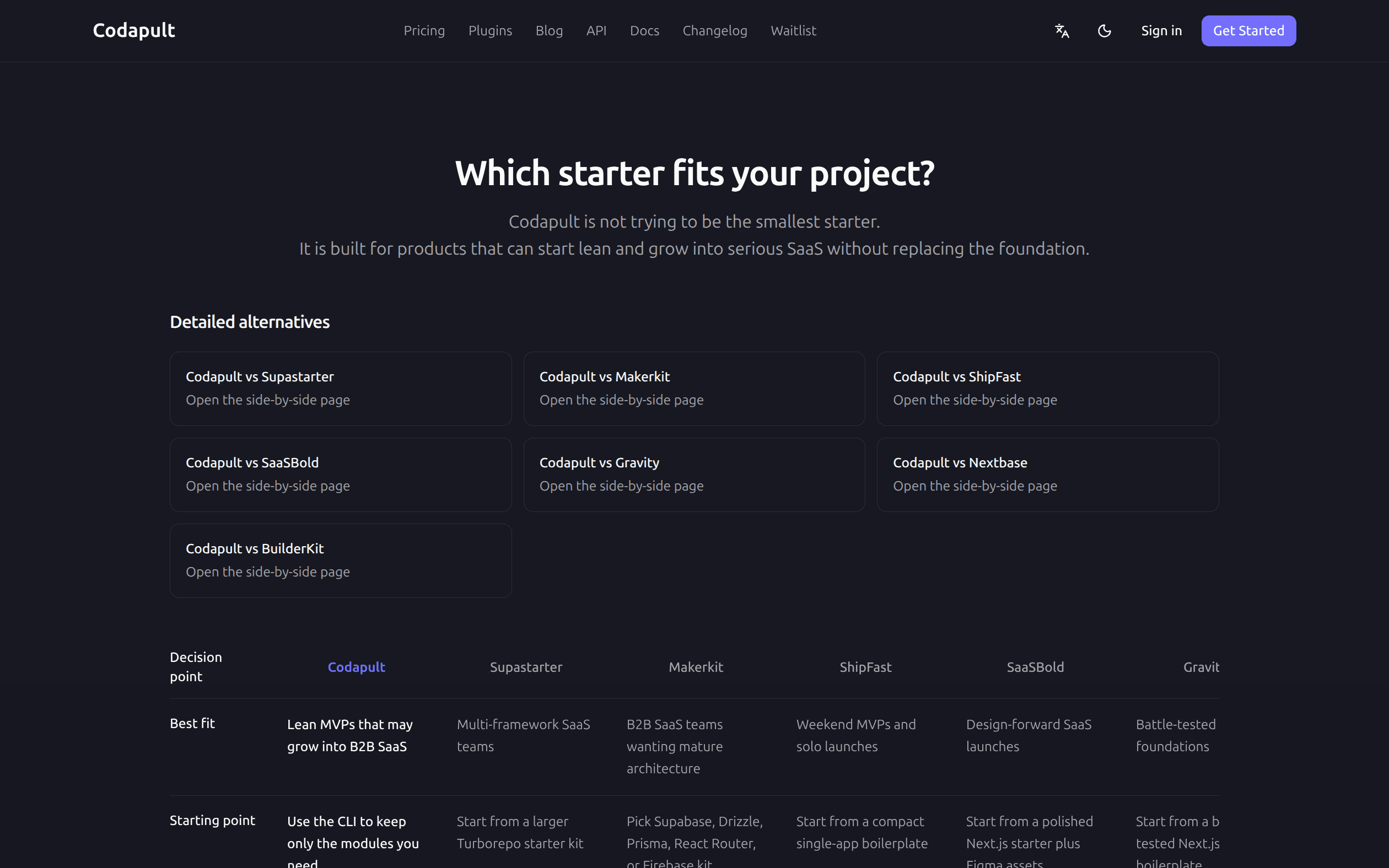
Quick Positioning
ShipFast is optimized for solo founders who want to launch a simple product quickly. It is direct, lightweight, and intentionally close to the marketing-site-plus-checkout shape.
Supastarter is a polished modern starter with strong monorepo conventions and broad SaaS coverage. It is a good fit when you like its chosen stack and want a well-packaged application foundation.
MakerKit is strong when you want a mature starter ecosystem and multiple stack choices, especially if Supabase or Firebase is central to your plan.
Codapult is for builders who want to start lean and grow without a rewrite. The setup wizard removes the modules your MVP does not need — permanently, from the codebase. What you keep is fully integrated and can be toggled via environment variables as the product evolves. You decide the scope at setup time instead of bolting missing pieces on later.
The Real Buying Question
The question is not "which starter has the most features?"
The better question is:
Which starter removes the work you are least likely to differentiate on, without boxing in the work you do need to differentiate on?
If your product is a narrow one-person launch, a smaller starter can be better. Less code means fewer decisions.
If your product will need teams, support operations, billing changes, admin tools, and integrations, the smallest starter can become expensive after launch. You may spend the saved setup time rebuilding the operational layer.
Architecture
Look at what happens when the product changes.
Can you remove a module? Can you switch providers? Can you add a plugin? Can you keep the public marketing site, dashboard, admin panel, API routes, and database schema understandable?
Codapult is built around a few architecture choices:
- App Router route groups for public, auth, dashboard, and admin surfaces.
- Provider adapters for auth, payments, storage, jobs, notifications, embeddings, and vector search.
- CLI setup wizard for permanently removing unused modules before you start building.
- Environment variable flags for toggling kept modules on or off after setup.
- MDX docs and blog on disk.
- A plugin registry for larger optional capabilities.
- Infrastructure paths for Vercel, Docker, Terraform, Pulumi, and Helm.
This is heavier than a minimal starter. The upside is that modules you keep are already integrated — no wiring needed when you turn them on. Modules you remove through the supported setup mappings have their mapped files and routes deleted; shared code and schema remain reviewable rather than being guessed at by the CLI.
Starting Simple with Codapult
Codapult connects a broad SaaS foundation without forcing every capability into your product.
The CLI setup wizard lets you keep only what your MVP needs. A typical minimal start looks like:
- Auth (email/password or OAuth)
- Billing (one provider, one plan)
- Dashboard (one route group for the logged-in user)
- Admin (user list and subscription view)
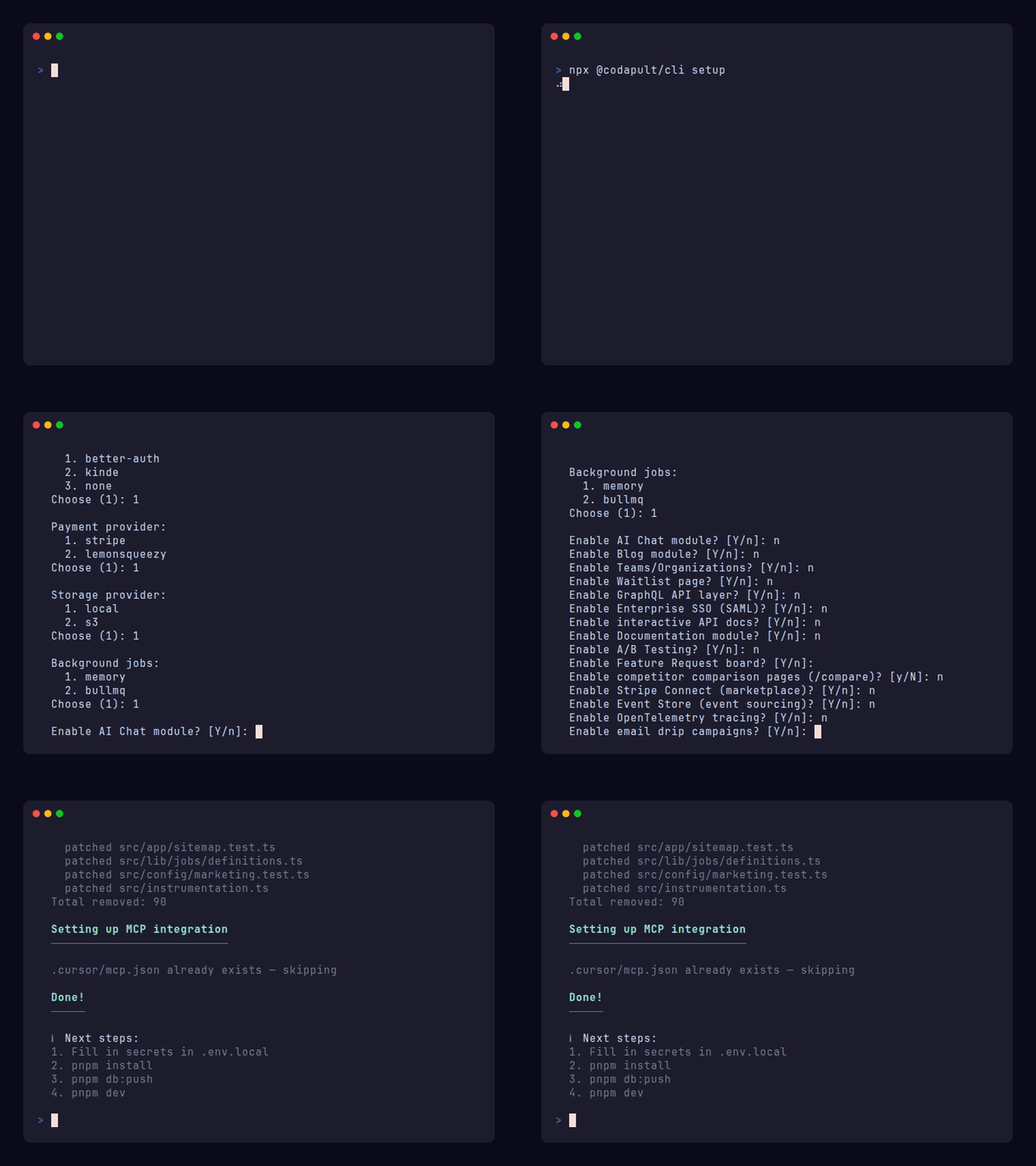
Everything else — teams, AI, SSO, SCIM, audit logs, white-labeling — you either remove at setup via the CLI wizard (permanent, clean), or keep in the codebase and hide via an environment variable until the product needs it.
This is the difference between Codapult and a minimal starter: you are not adding missing modules after launch. You are removing modules you do not need yet.
Billing
Billing is where a lot of starters look similar until you need a second pricing model.
Basic subscription checkout is useful, but SaaS pricing often evolves:
- One-time licenses.
- Monthly and annual subscriptions.
- Seats.
- Add-ons.
- Usage credits.
- Trials.
- Customer portal.
- Webhooks.
- Admin support workflows.
Codapult includes Stripe, LemonSqueezy, and Polar adapters. That matters less because of the provider names and more because billing code is not scattered across the app. The product can talk to a payment interface while the provider implementation stays behind it.
// Unified payment interface used across the entire application
export interface PaymentAdapter {
  createCheckout(params: CheckoutParams): Promise<{ url: string }>;
  createCustomerPortal(customerId: string): Promise<{ url: string }>;
  handleWebhook(req: Request): Promise<WebhookResult>;
  refundPayment(params: RefundParams): Promise<RefundResult>;
}
Database
Database preference is personal and team-specific.
Turso and Drizzle are lightweight and fast to start with. PostgreSQL is familiar, widely hosted, and often preferred by teams selling to enterprise buyers. Prisma has a huge ecosystem. Supabase gives you a bundled platform.
The practical advice:
- Pick Turso/Drizzle if you want a small TypeScript-first setup and like SQLite/libSQL ergonomics.
- Pick PostgreSQL if your team or customers expect it.
- Pick Supabase if managed auth/database/storage in one platform is the main value.
- Pick Prisma if your team strongly prefers its schema/client workflow.
Codapult defaults to Turso/Drizzle but also documents PostgreSQL support through DB_PROVIDER=postgres. That makes the default opinionated without making the buyer feel locked in.
Plugins and Product Surface
Most SaaS products do not need every module on day one.
But many products eventually need one or more of these:
- AI tooling.
- CRM workflows.
- Helpdesk workflows.
- Email marketing.
- Support analytics.
- Admin operations.
- Webhooks.
- Feature requests.
- Referrals.
Codapult treats larger optional capabilities as plugins where that boundary makes sense. The goal is not to turn every helper into a package. The goal is to keep the core application usable while letting serious capabilities be added as plugins when the product needs them. Plugins are separate from the core modules you select at setup — they can be installed independently at any point after launch.
When ShipFast Is the Better Choice
Choose ShipFast-style simplicity if:
- You are a solo founder shipping one small app.
- You do not expect enterprise workflows soon.
- You value minimal code more than operational breadth.
- You are comfortable adding missing modules yourself.
- You want a fast marketing and checkout path.
That is a valid product strategy.
When Supastarter or MakerKit Is the Better Choice
Choose Supastarter or MakerKit when:
- You like their stack choices.
- You want a mature starter with strong conventions.
- Supabase, Prisma, Firebase, or a specific monorepo shape is important.
- You want a broad starter without Codapult's plugin-oriented packaging.
The best starter is often the one that matches your team's taste and habits.
When Codapult Is the Better Choice
Choose Codapult when:
- You want to start with auth, billing, and a dashboard — and add teams, admin, AI, or SSO only when the product needs them.
- You want AI, docs, blog, billing, webhooks, and infrastructure already represented.
- You want to remove modules via CLI rather than add missing ones from scratch after launch.
- You expect teams and organization-scoped data at some point.
- You need admin operations for support, feature flags, or billing workflows.
- You want swappable providers — auth, payments, storage — without rewriting app logic.
- You may add CRM, helpdesk, email marketing, or AI platform features later (via plugins).
Codapult is less about the shortest path to a landing page and more about avoiding the second rebuild.
Decision Rule
Use the smallest starter that will survive the next version of your product.
If the next version is still one user, one plan, one dashboard, and one checkout, choose a smaller starter.
If the next version includes teams, operational support, provider changes, AI features, and customer-facing documentation, choose a starter that already has those boundaries.
If you are building a SaaS intended to evolve beyond a simple landing page without needing a complete rewrite down the road, explore the full architectural feature matrix and documentation on the Codapult comparison page.