Turso + Drizzle vs PostgreSQL + Prisma for a SaaS Boilerplate
A practical database trade-off guide for SaaS starters: SQLite/libSQL, PostgreSQL, Drizzle, Prisma, migrations, hosting, and buyer expectations.
Database choices in SaaS starters are more emotional than they should be.
Turso, PostgreSQL, Drizzle, Prisma, Supabase, Neon, and SQLite all have real strengths. The right choice depends on what the starter optimizes for: local setup, operational familiarity, edge reads, schema control, ecosystem, or enterprise expectations.
This is not a purity argument. It is a trade-off map.
Turso + Drizzle
Turso is hosted libSQL, a SQLite-compatible database with cloud features. Drizzle is a lightweight TypeScript ORM with explicit schema definitions and SQL-like query builders.
The appeal:
- Simple local development with
file:local.db. - Fast setup for new projects.
- Lightweight query layer.
- TypeScript-first schema and query types.
- Good fit for many SaaS workloads that do not need heavyweight relational operations on day one.
- Multi-region read replica story through Turso.
The cost:
- Some teams are less familiar with SQLite/libSQL in production.
- PostgreSQL has a larger ecosystem.
- Enterprise buyers may ask for Postgres by default.
- Some third-party tools assume Postgres.
Turso + Drizzle is a strong default when you value small setup and explicit TypeScript code.
PostgreSQL + Prisma
PostgreSQL is the familiar production default for many SaaS teams. Prisma is widely adopted and has a comfortable schema/client workflow.
The appeal:
- Very familiar to engineering teams.
- Huge hosting ecosystem: Neon, Supabase, RDS, Railway, Render, Fly, and more.
- Strong relational feature set.
- Many analytics, BI, and integration tools support it directly.
- Prisma has excellent discoverability and a large community.
The cost:
- Prisma can add more abstraction than some TypeScript teams want.
- Generated clients and migrations introduce their own workflow.
- Local setup can be heavier than an SQLite file.
- Switching away from Prisma later is rarely free.
PostgreSQL + Prisma is a strong default when team familiarity and ecosystem matter more than minimal setup.
PostgreSQL + Drizzle
This middle path is increasingly attractive precisely because it refuses to pick a side: you get PostgreSQL's familiar hosting story and Drizzle's thinner query layer. The trade-off is that you still need a real Postgres instance for local dev — no single-file convenience — and Drizzle's ecosystem, while growing, is smaller than Prisma's. For teams that think in SQL, this is often the most pragmatic option on the table.
What a SaaS Starter Should Do
A starter should make the default easy without pretending it is universal.
The docs should answer:
- What database is default?
- How do I run locally without a cloud account?
- How do migrations work before and after production data exists?
- Can I use PostgreSQL?
- If PostgreSQL is supported, which env vars change?
- Which schema file is the source of truth?
- What are the trade-offs?
The worst answer is silence. Buyers interpret silence as lock-in.
Migration Workflow Matters
For a fresh database, db:push is convenient.
For production data, generated migrations are safer.
That distinction should be explicit:
# Fresh local database
pnpm db:push

# Production changes
pnpm db:generate
pnpm db:migrate
Most SaaS teams can start fast and become stricter when real data appears.
Query Code Should Stay Boring
Regardless of provider, application code should import one database client:
import { db } from '@/lib/db';The app should not know whether the active provider is Turso or PostgreSQL. Provider selection belongs in database initialization, not in every route handler.
That boundary matters more than the default.
The Practical Recommendation
If fast local setup and multi-region reads matter most, start with Turso + Drizzle. If your team already knows Postgres, or your customers expect it, use Postgres — with Prisma if you want the generated-client ergonomics, or Drizzle if you'd rather write something closer to SQL. None of these is objectively correct. The mature answer isn't "this database is best" — it's picking a sensible default and documenting the escape hatch.
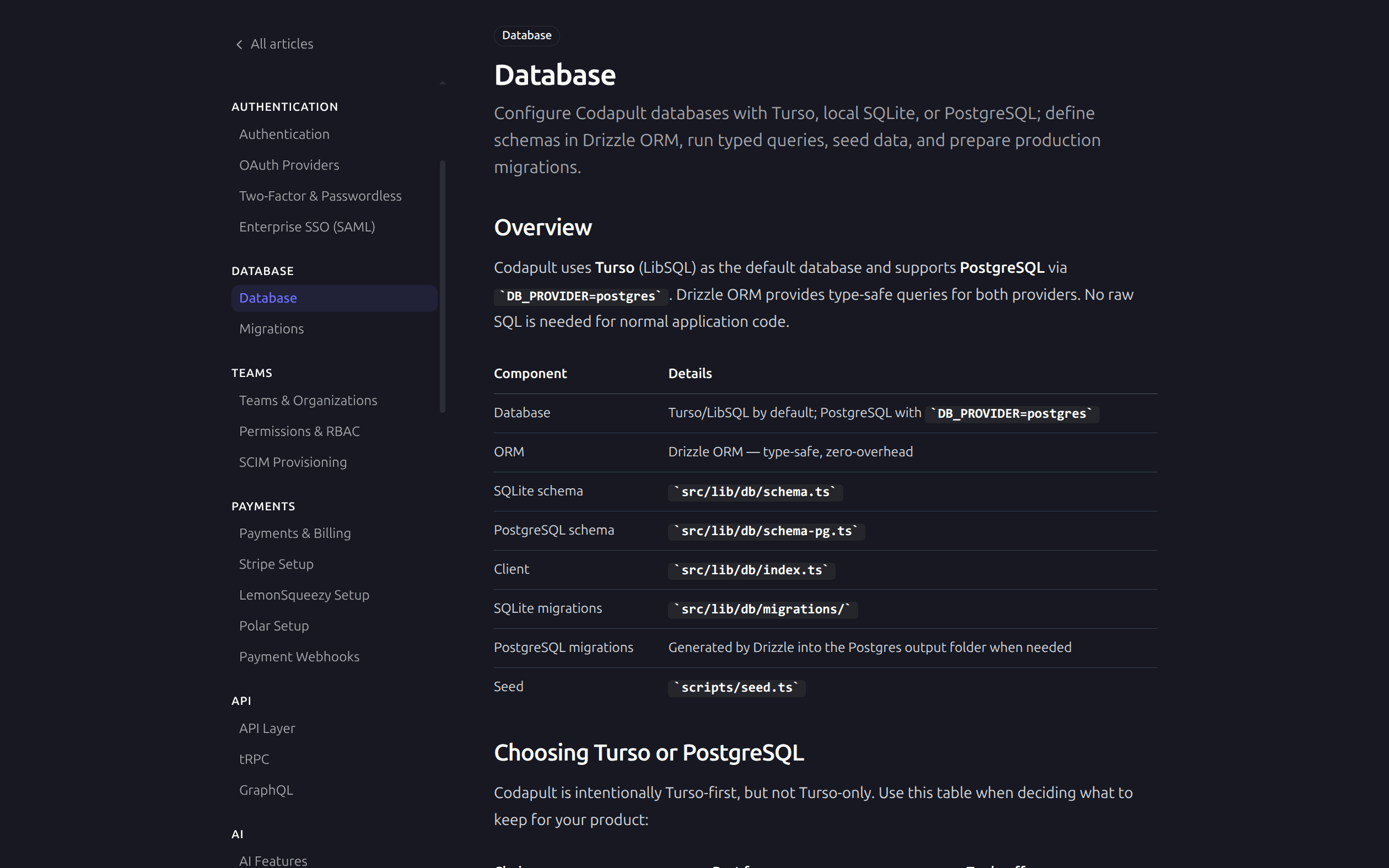
Codapult defaults to Turso + Drizzle and documents PostgreSQL via DB_PROVIDER=postgres; the database docs cover setup and migration paths.