The Next.js SaaS Boilerplate Checklist for 2026
A practical checklist for evaluating a Next.js SaaS boilerplate before you commit your product to it.
Most SaaS boilerplates look similar on the homepage: auth, payments, dashboard, emails, blog, and a fast launch promise. The differences appear later, when a customer asks for team roles, billing changes, audit logs, SSO, data export, custom domains, or a support workflow.
Use this checklist before you build on any starter.
1. Authentication Is More Than Sign-In
A serious SaaS foundation should answer these questions:
- Does it support email/password and OAuth?
- Does it support magic links or passkeys?
- Can you enable 2FA?
- Are protected routes handled consistently?
- Are auth API routes rate-limited?
- Can admins impersonate users for support?
- Can you switch auth providers without rewriting the app?
If auth is only a login form and a session hook, the real work is still ahead.
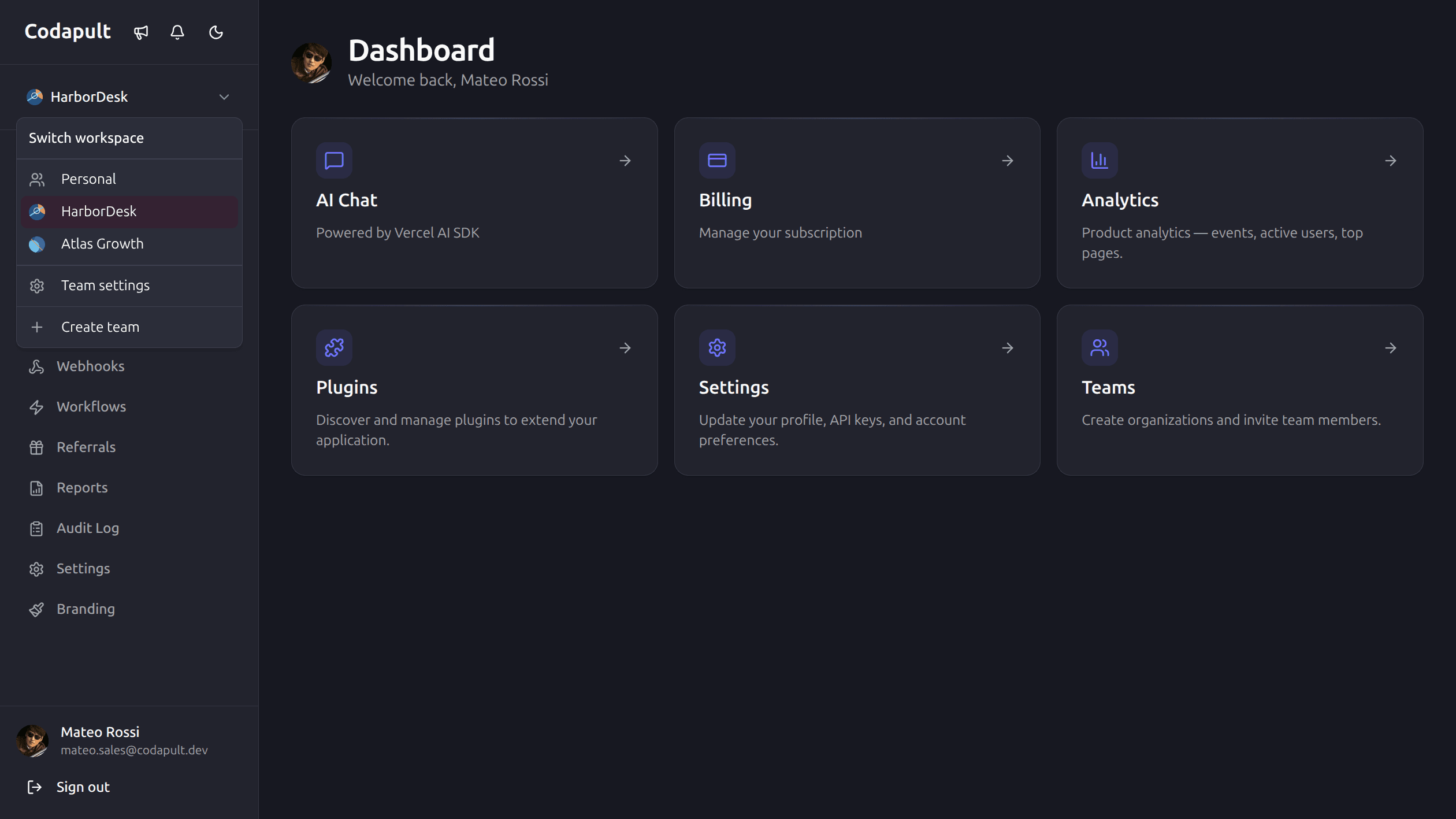
2. Teams Should Be First-Class
For B2B SaaS, the customer is often an organization, not a single user. The starter should model:
- Organizations or workspaces.
- Memberships.
- Roles.
- Invitations.
- Active organization context.
- Organization-scoped billing.
- Organization-scoped analytics.
- Organization-scoped webhooks.
Skipping this early usually creates painful migrations later.
3. Billing Needs Product Flexibility
Stripe checkout is useful, but it is not a complete billing model. Check whether the starter handles:
- Subscriptions.
- One-time purchases.
- Trials.
- Seat-based billing.
- Usage credits.
- Add-ons.
- Webhook verification.
- Customer portal links.
- Subscription state in the database.
- Admin subscription support.
Many products change packaging after launch. Your boilerplate should make that survivable.
4. Admin Is a Product Surface
Admin panels are often treated as internal afterthoughts. That is a mistake. Customer support, billing support, abuse response, feature flags, and rollout decisions all happen there.
Look for:
- User management.
- Subscription list.
- Waitlist or leads.
- Feature flags.
- Webhook logs.
- Activity logs.
- Performance and error visibility.
- Export flows.
A usable admin panel reduces support cost and launch risk.
5. The Database Layer Should Be Understandable
Before choosing a starter, inspect the schema:
- Are table names clear?
- Are relationships explicit?
- Are indexes present where lists and lookups need them?
- Are auth tables compatible with the auth library?
- Is the code tied to one database vendor?
- Are migrations documented?
The database is where boilerplate shortcuts become expensive.
6. API Boundaries Should Match the Product
A good SaaS starter should not force one API style everywhere. Type-safe internal product flows can use tRPC, public integrations can use REST or OpenAPI, and flexible clients may need GraphQL.
Check for:
- Input validation.
- Rate limits.
- Authenticated procedures.
- Admin-only procedures.
- Versioning for public APIs.
- Webhook signature verification.
- Clear error responses.
7. Email Is Not Just Transactional Templates
You need more than one welcome email:
- Verification.
- Password or magic link flows.
- Invitations.
- Billing events.
- Reports.
- Drip campaigns.
- Custom sender domains.
- Bounce or suppression handling.
If email is only a demo template, plan extra time.
8. Observability Should Be Wired Early
At launch, you need to know what broke and who was affected. Evaluate:
- Structured logs.
- Error reporting.
- Web vitals.
- Analytics events.
- Audit logs.
- Webhook delivery records.
- Background job visibility.
These systems are much easier to wire before production traffic arrives.
9. SEO and Content Matter for SaaS Starters
If the starter includes marketing pages, verify:
- Metadata per page.
- Open Graph images.
- Sitemap.
- Robots rules.
- Blog RSS.
- Canonical URLs.
- FAQ schema where appropriate.
- Product schema on pricing pages.
- Noindex for auth, dashboard, and admin pages.
Marketing infrastructure is part of the product when your acquisition depends on search.
10. Deployment Should Not Be a Single Happy Path
Vercel is a great default, but your customers or internal constraints may push you elsewhere. Look for:
- Docker support.
- CI/CD examples.
- Environment variable reference.
- Infrastructure-as-code examples.
- Background job guidance.
- Storage configuration.
- Production checklist.
Final Decision Rule
The right question is not "how complex is my product today?" but "how expensive will it be to add what I need next?"
A minimal starter is fast to start and painful to grow. A modular starter lets you begin with only auth, billing, and a dashboard — and add teams, admin, AI, or SSO when the product actually needs them. With Codapult, you remove what you don't need via CLI. You don't add missing modules from scratch six months after launch.
The right boilerplate should help you launch faster without forcing a rewrite after the first serious customer.
Codapult was built against this checklist. If you want to verify it item by item, the compare page maps each capability to what ships in the box, including modules, adapters, infrastructure, and plugins.