Why Modular Beats Minimal: The Rewrite Nobody Talks About
Minimal SaaS starters feel fast at the start. Here is what happens six months later when your product needs teams, billing changes, admin tools, and a first enterprise customer.
Why Modular Beats Minimal: The Rewrite Nobody Talks About
There is a version of this story that every indie founder knows.
You picked a minimal starter. You shipped fast. The product started getting traction. Then a customer asked for team accounts. Another asked for an invoice. A third asked about SSO. You spent the next two months rebuilding the foundation you thought you were skipping.
This is the rewrite nobody talks about. Not the one where you throw the product away — the slower, more expensive one: the feature-by-feature retrofit of the operational layer your boilerplate did not include.
The False Economy of Minimal
Minimal starters are genuinely fast for the first deployment. If the product never needs anything beyond a login form and a checkout link, a minimal starter is the correct choice.
The problem is predicting that in advance.
Most SaaS products that get traction eventually encounter:
- A customer who wants to add a colleague
- A billing change (annual plans, seat pricing, trials)
- An admin workflow (refund a subscription, ban an account, toggle a feature)
- A compliance question (who accessed what and when?)
- An enterprise prospect asking about SSO
None of these are unusual. They are the second chapter of most products.
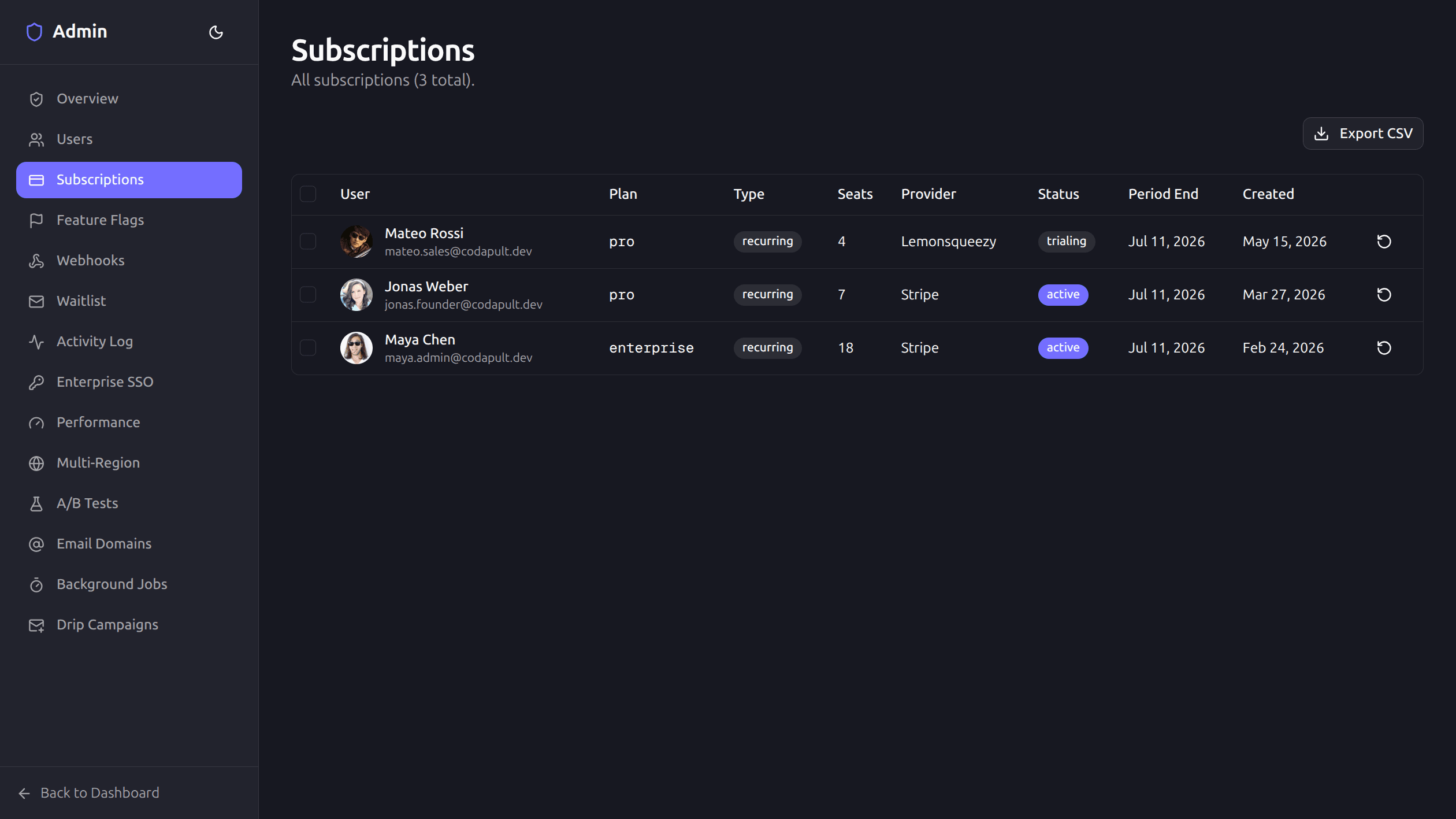
What "Modular" Actually Means
Modular does not mean complex. It means the architecture already has the boundaries where the common growth points live.
With Codapult, the setup CLI makes this decision concrete: you choose which modules to include before you start building. Modules you remove are stripped from the codebase permanently — no dead code, no unused schema tables. Modules you keep are fully integrated and can be toggled on or off via env vars as needed.
This is not "we will add it later via a command." It is "we decided at setup time what this product needs, and everything else is gone."
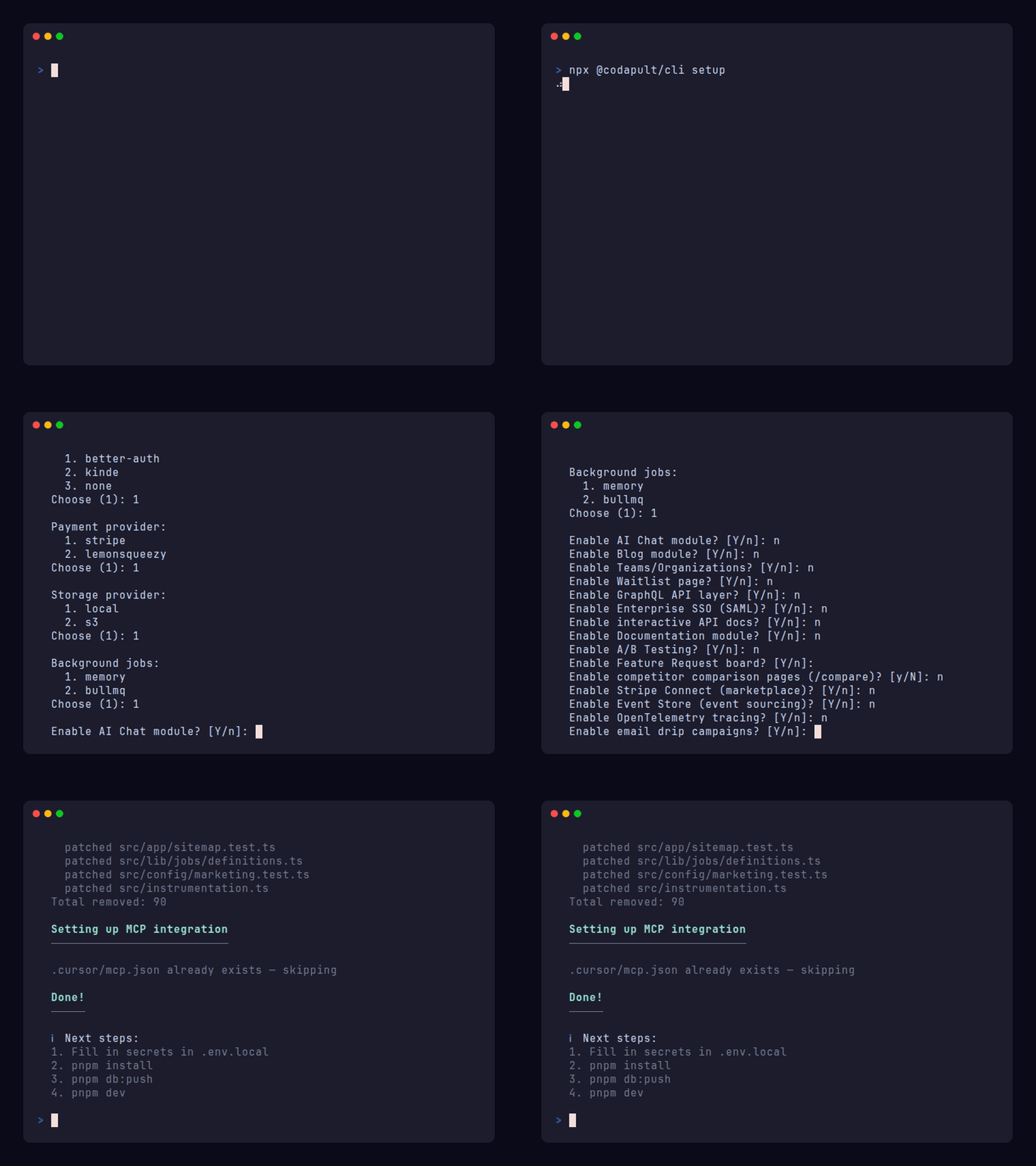
The key architecture choices that survive the decision:
- Provider adapters for auth, payments, storage, jobs, notifications — each behind a clean interface. Switching from Stripe to Polar changes one env var.
- Route groups for public, auth, dashboard, and admin surfaces — boundaries are explicit from day one.
- Schema designed for the modules you kept — no orphaned tables from features you removed.
The Retrofit Cost
Here is a rough estimate of what these modules cost to add after launch — assuming you build on top of an existing auth/payment provider rather than implementing protocols from scratch, which is the realistic path for most teams:
| Module | Time to build from scratch |
|---|---|
| Teams and organizations | 1–2 weeks |
| Role-based permissions | 3–5 days |
| Billing webhooks and state sync | 2–3 days |
| Admin panel (users, subs, flags) | 1–2 weeks |
| Audit logs | 2–3 days |
| SAML SSO (via a managed provider) | 2–4 days integration, plus IdP testing per customer |
| AI chat with provider routing | 3–5 days |
| Outbound webhooks | 2–3 days |
That is 4–7 weeks of work that produces no user-visible product improvement. Pure foundation debt. Building SAML without a managed provider — parsing assertions, handling XML signature edge cases, testing against real IdPs — realistically runs into months, not days, which is exactly why almost nobody does it from scratch anymore.
With Codapult, modules you included at setup are already integrated. The cost is configuration, not construction.
The Decision Is Made at Setup Time
This is the practical difference between Codapult and a minimal starter:
With a minimal starter, you start small and build the operational layer later — from scratch, one missing piece at a time.
With Codapult, you decide at setup what the product needs. Modules you include are wired in. Modules you remove are gone cleanly. There is no "add it later via CLI" for removed modules — that is a deliberate trade-off, not a limitation. You get a smaller, more understandable codebase instead of a toggleable monolith.
The question to ask before setup:
Which modules would be expensive to build from scratch six months from now?
Keep those. Remove the rest.
When Minimal Is Still the Right Answer
Not every product needs all of this. A minimal starter is correct when:
- The product is genuinely one user, one plan, forever
- You are validating an idea in a week and will rebuild regardless
- The team's main constraint is learning Next.js and less code helps
If any of those are true, pick the smallest starter available.
But if your product has a realistic path to teams, billing changes, operational tooling, or enterprise sales — the question is not "which starter has less code?" It is "which starter will survive the next version of my product without a rebuild?"
Starting Lean with Codapult
The minimal Codapult setup:
- Run the CLI setup wizard
- Remove teams, SSO, SCIM, white-labeling, AI chat, referrals at setup
- Configure auth + one billing provider + email
- Deploy
You get a small codebase — auth, billing, dashboard, admin — with proper provider abstractions already in place. When the product needs a different billing provider, it is one env var. When it needs SSO, you add that module from the source repo and it fits cleanly into the existing auth adapter pattern.
The 70+ modules Codapult ships with are not forced into your app. You choose at setup time. What you keep is clean. What you remove is gone.
The Decision That Matters
The choice between minimal and modular is a bet on the future of your product.
If the product stays simple: minimal wins. Less code, faster start.
If the product grows — and most that get traction do — the question is whether you made the right module decisions at setup time. The modules you kept cost nothing to configure. The modules you removed cost real time to add back.
The rewrite nobody talks about is expensive. It is worth spending ten minutes on the setup wizard to avoid it.
Codapult ships with 70+ modules and a CLI setup wizard to keep only what your product needs from day one. See what's included →