Architecture
Stop letting infrastructure decisions leak into your product.
Codapult keeps product logic, infrastructure and agent context in explicit layers — so you can change providers, modules or workflows without turning the codebase into a vendor-specific maze.
Architecture contract
Visible to your team and your AI agent.
4
provider boundaries
1
business logic layer
0
vendor rewrites required
Typed boundaries · explicit adapters · inspectable conventions
The shape of the system
Your business logic should not care which vendor you choose.
Keep the application you own. Swap the infrastructure behind it when the product, budget or deployment needs change.
Product layerReplaceable infrastructure
Your SaaS
Business logic
01
Own the domain
Your SaaS
02
Keep the seam
Business logic
03
Swap the edge
Adapters
Adapter architecture
Your business logic shouldn’t care which vendor you choose.
Select a boundary to see what changes at the edge — and what your product keeps forever.
Auth frontière
Better Auth · Kinde
Identity stays behind a typed boundary. Your product works with users, sessions and organizations — not provider-specific calls.
$ User → auth adapter → session → organization
Session and user contracts
Organization membership
Permission checks
Replaceable edges, familiar tools
Next.js 16
TypeScript
PostgreSQL
Turso
Drizzle ORM
Tailwind CSS
Better Auth
tRPC v11
Stripe
Vercel
Your SaaS
Pages, product flows and business rules stay focused on what makes your product different.
Application boundaries
Auth, billing, email, storage and database contracts isolate infrastructure decisions.
Infrastructure
Providers can change without forcing product code to learn their APIs everywhere.
Espace de travail CodapultMarketingPrimary.pages.shared.productDomain
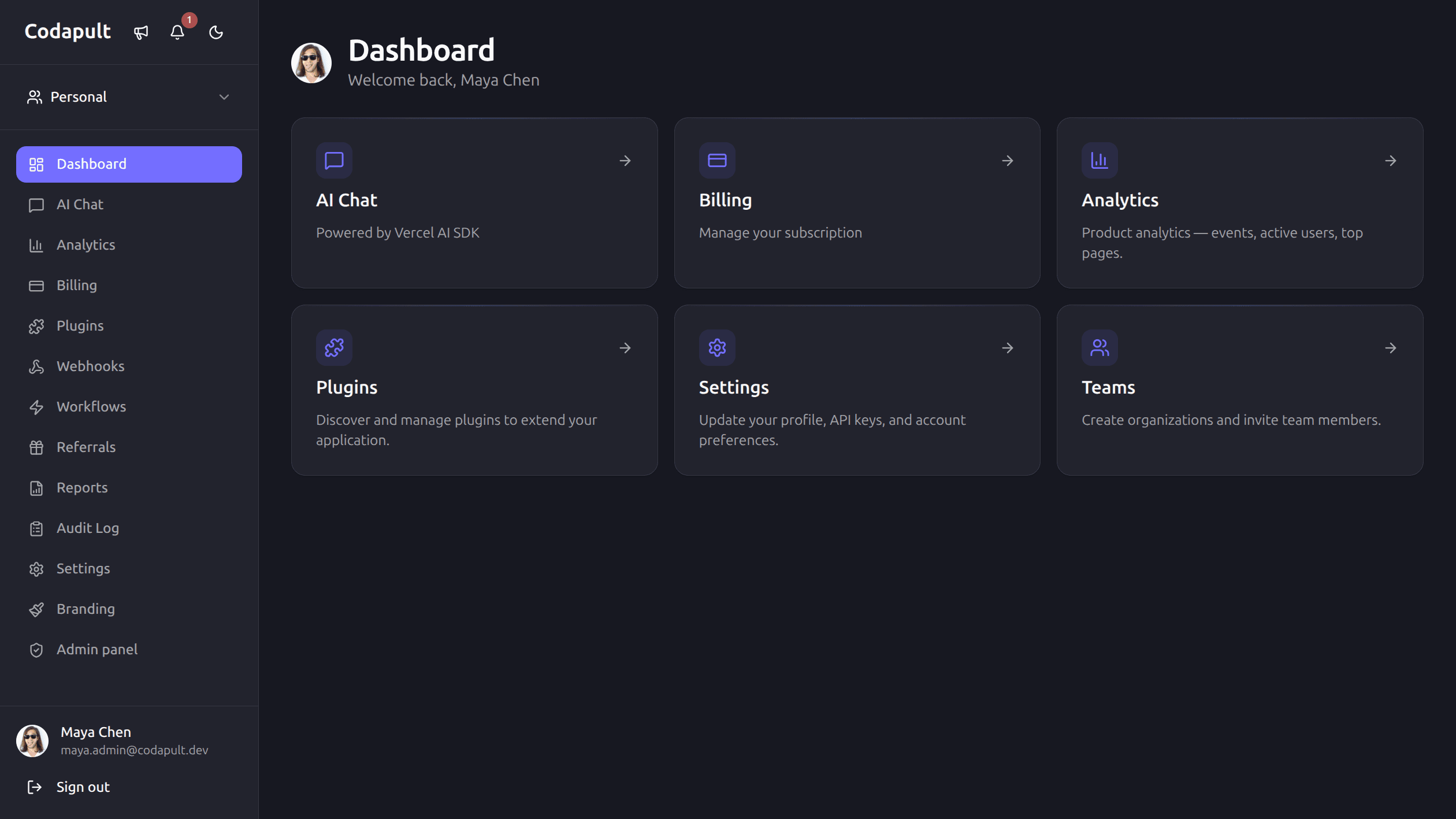
Designed for change
The seams are a feature.
A new provider, module or AI workflow should be a controlled change at a known boundary — not a rewrite of every screen and server action.
- Domain code stays readable
- Infrastructure stays replaceable
- Agents get the same map your team uses
Change without a rewrite
The architecture earns its keep every time the product changes.
01
Switch providers
Replace an adapter at the edge while the domain stays intact.
02
Remove modules
Keep only the capabilities your product actually ships with.
03
Change the database
Use PostgreSQL or Turso without changing the application contract.
04
Let agents inspect
Expose conventions, schemas and boundaries as structured context.
Build on boundaries your agent can understand.
Read the conventions, inspect the schema, and start with the foundation.